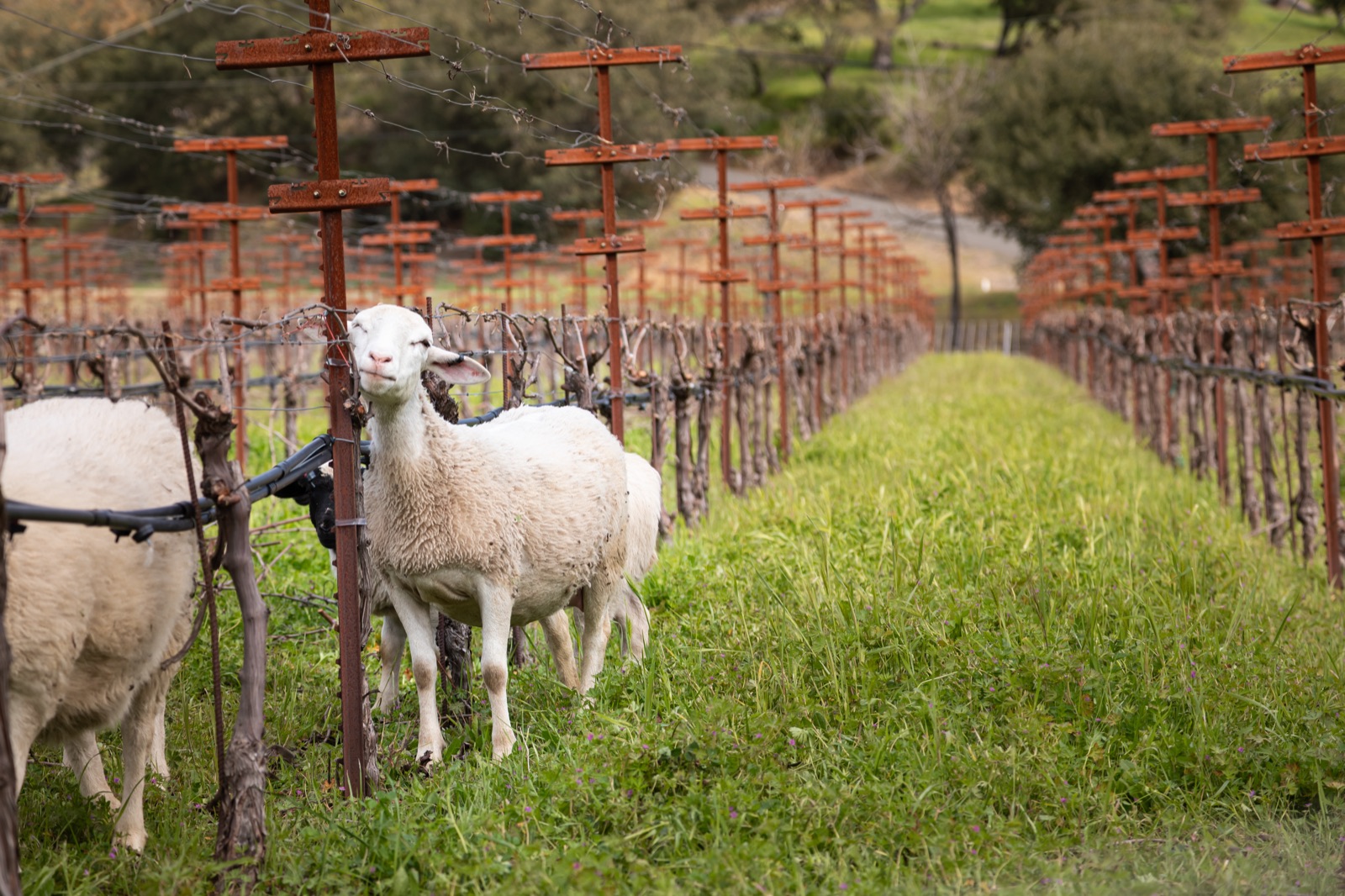
Most people’s mental image of a Napa vineyard is something manicured and quiet. Perfectly spaced rows, bare soil between the vines, everything orderly. That’s not what a healthy vineyard looks like. A healthy vineyard is alive. It’s a little messy. And if you come to Baldacci at the right time of year, it has sheep in it.
Those sheep are not a marketing choice. They live on the property year-round, and they do real work. Understanding what that work is, and why we farm the way we farm, is what distinguishes our vineyards from others.
Why Are There Sheep in Our Vineyards?
The flock lives at Baldacci all year, and their job changes with the season.
In late spring through early fall, when the vines are growing and carrying fruit, the sheep work the hillside areas and any open land on the property that isn’t planted to grapevines. This is fire abatement: grazing the dry grasses and brush that can turn a hillside into a fire risk in a California summer. This is unglamorous, practical work, and it matters.
After harvest, the job shifts. We seed a cover crop in the vineyard rows: a mix of plants that will grow through the winter, build organic matter, and fix nitrogen back into the soil. We let that cover crop establish and make some real growth. Then we bring the sheep in.
What the sheep do in the vineyard is more sophisticated than it might look. They eat the cover crop down, which sounds like destruction but is actually the point: grazed plants put energy into root growth and regrowth, which means more biomass cycling through the soil over time. Their hooves break up the surface of the soil, which improves water penetration and aeration. And they fertilize as they go, returning nutrients to the ground in a form that’s immediately available to soil organisms.
A tractor can mow a cover crop. A tractor cannot do what a sheep does. We think of the sheep program as regenerative farming. Not just sustaining the land, but actively improving it year over year.
What CCOF Certification Actually Means
Baldacci is certified organic through CCOF, the California Certified Organic Farmers organization. CCOF certification is rigorous. It requires documented farming plans, regular inspections, and a clear record of what goes into the vineyard and what doesn’t.
The short version of what it means in practice: no synthetic pesticides, no synthetic herbicides, no synthetic fertilizers. Everything that enters the vineyard must be permitted under the certified organic standards. We follow those standards because we believe it is the best way to farm.
That distinction matters. There are wineries that pursue certification because the marketing helps, and there are wineries that farm this way because it’s what they believe in. The farming decisions look similar on paper, but the intention behind them is different. At Baldacci, the certification came after the commitment, not the other way around. We were already farming sustainably before we went through the certification process. When we finally did, and when we earned it, there was real pride in that. It was recognition of something the family had been working toward for a long time.
What we use instead of synthetic inputs: cover crops that build soil health, compost, and the sheep. Integrated pest management that works with the ecosystem rather than against it. Sulfur and copper applications permitted under organic standards when disease pressure requires them. The goal in all of it is a living soil, because a living soil is what produces the most expressive fruit.
Organic vs. Biodynamic vs. Sustainable: The Key Distinctions
The short version: sustainable is a broad commitment with no single standard, organic is a legal definition that bans synthetic inputs and requires third-party certification, and biodynamic layers Rudolf Steiner’s practices on top of organic.
These three words get used interchangeably in wine marketing, and they shouldn’t be.
Sustainable is the broadest category and the least defined. It generally means the winery is making an effort to reduce its environmental impact, but there’s no universal certification or standard. A sustainable winery might use some synthetic inputs under controlled circumstances. Many California wineries participate in the California Sustainable Winegrowing program, which is meaningful but not the same as organic.
Organic has a legal definition. To label a wine “organic” or to claim organic farming, you have to meet the USDA National Organic Program standards and typically carry a third-party certification like CCOF. The inputs are restricted. The inspections are real. It’s a higher bar than sustainable.
Biodynamic goes further than organic in some ways and in a different direction in others. Biodynamic farming includes all the restrictions of organic plus a specific set of practices derived from Rudolf Steiner’s agricultural philosophy: planting by lunar calendars, making preparations from fermented herbs and animal materials, burying things in the soil at specific times of year. Some of those practices have measurable effects on soil biology. Others are harder to evaluate empirically.
Where does Baldacci sit? We’re CCOF-certified organic, and we do things that align with regenerative farming principles: the sheep, the cover crops, building soil health over time. We don’t follow a biodynamic calendar or do the biodynamic preparations. The work in the vineyard should be grounded in what we can observe and measure and improve. For us, that’s the organic and regenerative approach.
Why We Farm This Way
The simple answer is that it’s the right thing to do to sustain the land, and we believe it produces better wine.
Farming organically is harder than the alternative in some ways. There’s more labor involved. When disease pressure hits, you have fewer options for a fast response. There are years when a conventional vineyard might yield a cleaner crop than an organic one, because a targeted synthetic pesticide application can address a problem that takes longer to manage organically.
We do it anyway, because we’re farming land we intend to hand to the next generation in better shape than we found it. That’s not a marketing statement. It’s the actual calculation we make when we look at the property.
There’s also what the soil biology produces over time. A vineyard farmed organically for fifteen or twenty years develops a genuinely different microbial ecosystem from one that has been managed conventionally. The diversity of organisms in the soil (bacteria, fungi, invertebrates) is measurably higher. That diversity translates into a more complex root interaction with the soil, which translates into more complexity in what the vine produces.
Healthy soil makes more expressive wine. The connection is real and it compounds over time. Every year that we build the organic matter in the soil, the cover crop has more to work with, and the vine has a richer environment to draw from. It is a long game, and we’re playing it.
What a Healthy Vineyard Actually Looks Like
A healthy vineyard in winter looks a little overgrown: cover crop is knee-high in the rows, grazed patches, hoof prints in soft soil, not bare tilled ground.
The manicured Napa vineyard with bare, tilled soil between perfectly uniform rows is not what we’re doing. And it’s not actually what the most serious farmers in the valley are doing either.
A vineyard with a healthy cover crop in late winter looks almost weedy to someone used to seeing bare ground between the vines. There’s a carpet of plants growing in the rows. Some of it is intentionally seeded; some of it is volunteer growth from seeds already in the soil. By the time the sheep come in, the cover crop is knee-high in places, and the rows have a lush, overgrown quality.
Guests who see the vineyard in this state sometimes ask if something is wrong. Nothing is wrong. This is what it’s supposed to look like. The conventional bare-soil vineyard is a product of tillage and herbicides. The cover crop vineyard is a product of letting the land do what it wants to do, then managing that growth in a productive way.
After the sheep have come through, the rows look different again: grazed down, with hoof prints in the soft soil, sheep manure scattered through the rows. Not manicured. Alive.
By bud break in spring, the cover crop is greening up again, the vines are waking up, and the process starts over. It’s a continuous cycle of building and returning. That’s what regenerative farming looks like in practice.
Organic Farming and What It Does to the Wine
What organic farming changes is the biology of the soil, not the geology beneath it, and over the years that biological richness shows up in the glass as more layered, more site-expressive wine.
We make Cabernet Sauvignon from the Stags Leap District, a place already known for producing wines with a particular combination of structure and elegance. Part of what gives Stags Leap Cabernet its character is the specific soils of the appellation: volcanic and alluvial, complex in their mineral composition.
Farming organically doesn’t change the underlying geology. But it does change the biological layer on top of it. The mycorrhizal fungi that help vine roots access water and nutrients, the bacteria that cycle nitrogen, the earthworms and other invertebrates that aerate the soil and process organic matter: all of these are more abundant and more diverse in an organic farming system. That richness in the soil translates to a richer interaction between the vine and its environment.
The result, over time, is wine that expresses its place more fully. Not a different wine, but a more complete version of what the site can produce. The flavors are more layered. The aromatics are more complex. The wine has more to say.
This is a subjective claim and I know it. Soil science can measure microbial diversity, but it cannot directly measure the impact on a finished wine. What I can say is that this is what we observe, and it’s what we believe. The land we farm organically shows it in the glass.
Other Wineries who Farm Organic Vineyards in Napa Valley Worth Knowing
We are not the only ones farming this way, and I would like you to know who else is doing it. If organic farming is part of what brings you to Napa, these producers are worth your time:
- Frog’s Leap Winery (Rutherford). Farming organically since the late 1980s and dry farming much of the estate.
- Spottswoode Estate (St. Helena). Organic since 1985 and CCOF certified. A benchmark for estate Cabernet grown this way.
- Robert Sinskey Vineyards. With vineyards in Carneros, certified organic and farmed biodynamically for decades.
- Grgich Hills Estate. All estate vineyards are certified organic. One of the largest fully organic estates in the valley.
- Ehlers Estate (St. Helena). CCOF-certified organic Cabernet from a single contiguous estate surrounding the winery.
- Long Meadow Ranch (St. Helena). Certified organic farming across a full working ranch: vineyards, olive groves, gardens, and livestock.
- Storybook Mountain Vineyards (Calistoga). Organically farmed hillside Zinfandel from a family estate since the 1970s.
Each of these wineries farm differently than we do, and that’s the point. Organic is a standard, not a style. If you’re building a first Napa itinerary around producers like these, our guide to the best wineries in Napa for first-timers covers the planning side.
For the Values-Aligned Visitor: Tasting at an Organically Farmed Napa Winery
If you care about how your food and wine are produced, Baldacci is a place that takes that seriously. The CCOF certification is publicly verifiable. The sheep are not a photo opportunity. They’re working animals doing a real job. The farming decisions we make would be the same if no one were watching.
We offer estate tastings that include the story of how we farm, because we think it matters to understand what’s in the glass. If you want to know what a working organic vineyard in the Stags Leap District looks and tastes like, come during the late winter or early spring when the cover crops are up and the sheep are in the rows. Come at any time and we’ll tell you what we do and why. Most visits include time in our estate wine cave; our guide to Napa wine tasting covers what to expect.
Joining our wine allocation program is also a way to stay connected to what we’re building here. Members receive wines from each vintage, and over time those bottles represent years of work in the soil. The wine that comes from a well-farmed vineyard is different in a way that accumulates. We think that’s worth experiencing annually. You can also browse our current releases from home.
Book your tasting at Baldacci →
Learn about our wine allocation program →
FAQ
What does it mean to farm organic vineyards in Napa Valley? An organic winegrape grower farms without synthetic pesticides, herbicides, or fertilizers, following standards set by the USDA National Organic Program. In California, CCOF (California Certified Organic Farmers) is the primary third-party certifier. Baldacci Family Vineyards is CCOF-certified organic and has been farming to these standards for years.
What wineries in Napa Valley farm organic winegrapes? A growing number of Napa producers farm organically, though not all carry formal certification. CCOF maintains a searchable directory of certified organic operations in California. Baldacci is a certified organic producer in the Stags Leap District. When evaluating any winery’s organic claims, a third-party certification is the most reliable signal.
Do wineries use sheep in vineyards? Yes. Sheep grazing is a legitimate and increasingly common vineyard management practice. At Baldacci, the flock grazes cover crops post-harvest, returning nutrients to the soil, breaking up the surface with their hooves, and building organic matter. In summer, they manage fire risk on the property’s hillside areas. It’s not a gimmick. The sheep do agricultural work that would otherwise require machinery or herbicides.
What is the difference between organic and biodynamic vineyards? Organic vineyards are farmed without synthetic inputs, certified to national standards. Biodynamic farming adds a layer of specific practices derived from Rudolf Steiner’s agricultural philosophy, including lunar planting calendars and preparations made from fermented plant and animal materials. Biodynamic is a superset of organic for most certifications. Baldacci is certified organic and practices regenerative farming but does not follow a biodynamic protocol.
Is a sustainable vineyard the same as an organic vineyard? No. Sustainable is a broader, less defined category. Sustainable farming programs allow some synthetic inputs under controlled conditions and typically involve a commitment to reducing environmental impact over time. Organic has a legal definition and requires third-party certification. A winery can be sustainable without being organic, but organic farming is generally more stringent.
Can you taste the difference between organic and conventionally farmed wine? This is debated, and the answer is that it’s hard to isolate. What we observe at Baldacci is that healthy, biologically rich soil produces vines with a more complex root environment, which over time produces wines that are more expressive of their site. Whether that’s attributable to organic farming specifically or to the overall quality of the farming is hard to separate. We believe the connection is real. Soil science on microbial diversity in organic versus conventional vineyards supports the idea that something meaningful is different.
What is regenerative farming in a vineyard? Regenerative farming goes beyond sustaining land in its current condition to actively build and improve soil health over time. At Baldacci, that means grazing sheep to add organic matter and break up soil compaction, cover crops that fix nitrogen and feed soil biology, and farming decisions designed to increase biodiversity and resilience over the long term. Organic certification is a foundation; regenerative is the direction we’re moving toward.
Where can you taste wines from organic vineyards in Napa? Start with certified producers whose farming you can verify: Baldacci in the Stags Leap District, Frog’s Leap in Rutherford, Spottswoode in St. Helena, Grgich Hills Estate, and Robert Sinskey Vineyards. Tasting at a certified organic estate lets you taste the farming itself rather than reading about it on a label. CCOF’s public directory lists every certified operation in California.
Are there family-owned organic vineyards in Napa Valley? Yes. Baldacci Family Vineyards is family owned and CCOF-certified organic, with the family farming the Stags Leap District estate and the sheep living on the property year-round. Several other certified organic Napa producers, including Spottswoode and Storybook Mountain, are family owned as well. Family ownership and organic farming tend to move together: both are long-horizon decisions about the same land.
Michael Baldacci is the winemaker at Baldacci Family Vineyards, Stags Leap District, Napa Valley.