When most people ask about Napa Valley, they’re picturing the big ideas: the Silverado Trail, the sunshine, and Cabernet. But Napa Valley is made up of 17 smaller appellations, each with its own soil, climate, and flavor profile. This isn’t just marketing; it’s academic. An AVA (American Viticultural Area) is a federally designated grape-growing region defined by distinct geographic or climatic features, established and regulated by the Alcohol and Tobacco Tax and Trade Bureau (TTB). The differences are real, and if you spend a little time tasting wines from different parts of the valley, you can spot them in the glass, even without looking at the label.
I farm in the Stags Leap District, where the Baldacci winery is located, but over the years I’ve tasted wines from every corner of Napa Valley. Some of these appellations I know because I farm my own vineyards and produce my own wines from them. Others I’ve learned about through study and sharing bottles with friends and colleagues. My goal here is to give you a practical map you can use, not just a list of names. Here’s what each appellation brings to the table, and what makes them unique.
The Geography That Makes the Flavor Differences Make Sense
If you want to understand why Napa’s appellations taste different, it mostly comes down to three things: how far each is from San Pablo Bay, the elevation, and the origin of the soils.
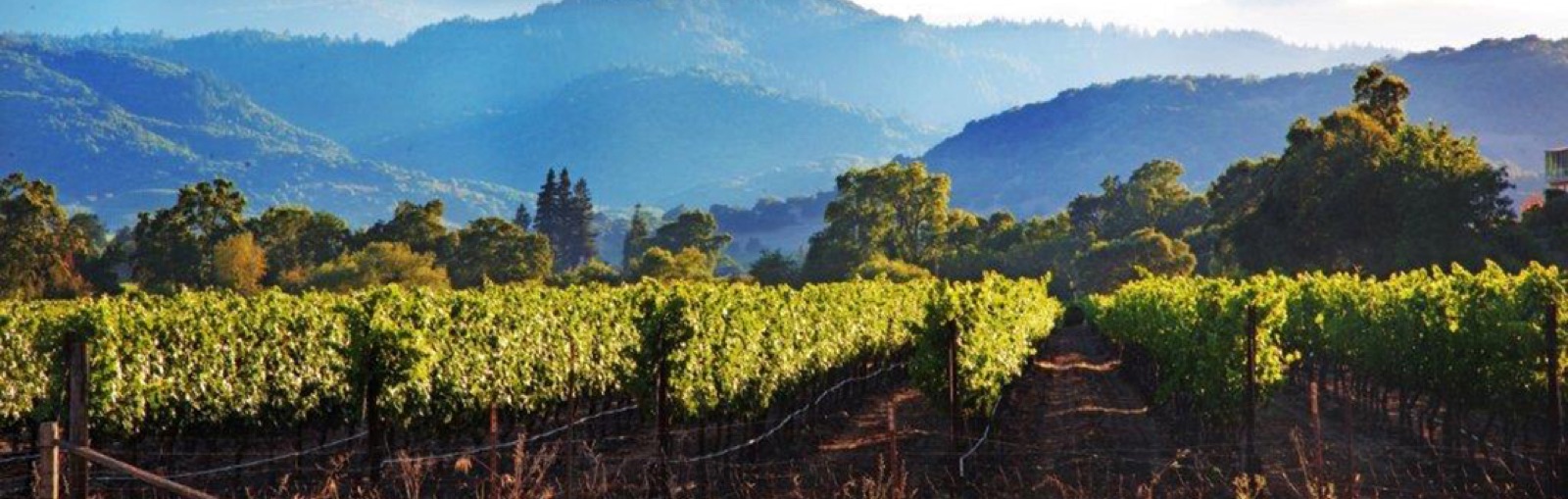
Before we dive into each appellation, it helps to know a bit about the Valley’s physical shape and how that influences the wines. Napa Valley runs about 30 miles from north to south, stretching from the city of Napa at the southern end up to Calistoga at the northern tip. The Mayacamas Mountains form the western range, and the Vaca Mountains form the eastern range. This terrain controls how the weather moves through the Valley. The southern end opens to San Pablo Bay, and from there a marine influence pushes north: morning fog, cooler temperatures, strong afternoon winds. By the time you get to Calistoga, 30 miles north, you’re cut off from that marine influence by a narrowing of the valley and a ring of mountains. Calistoga regularly runs 10 to 15 degrees warmer than Carneros at the Valley’s southern edge.
That temperature shift from south to north is the key to understanding every appellation here. The closer you are to the Bay, the more you’ll find cool-climate character: higher acidity, more restrained fruit, and wines that often need a little patience. As you move north and inland, the wines get richer and more generous. The mountains add another layer. Elevation brings bigger temperature swings, thinner soils, and a structure you don’t get on the Valley floor.
The 17 Napa Sub-Appellations
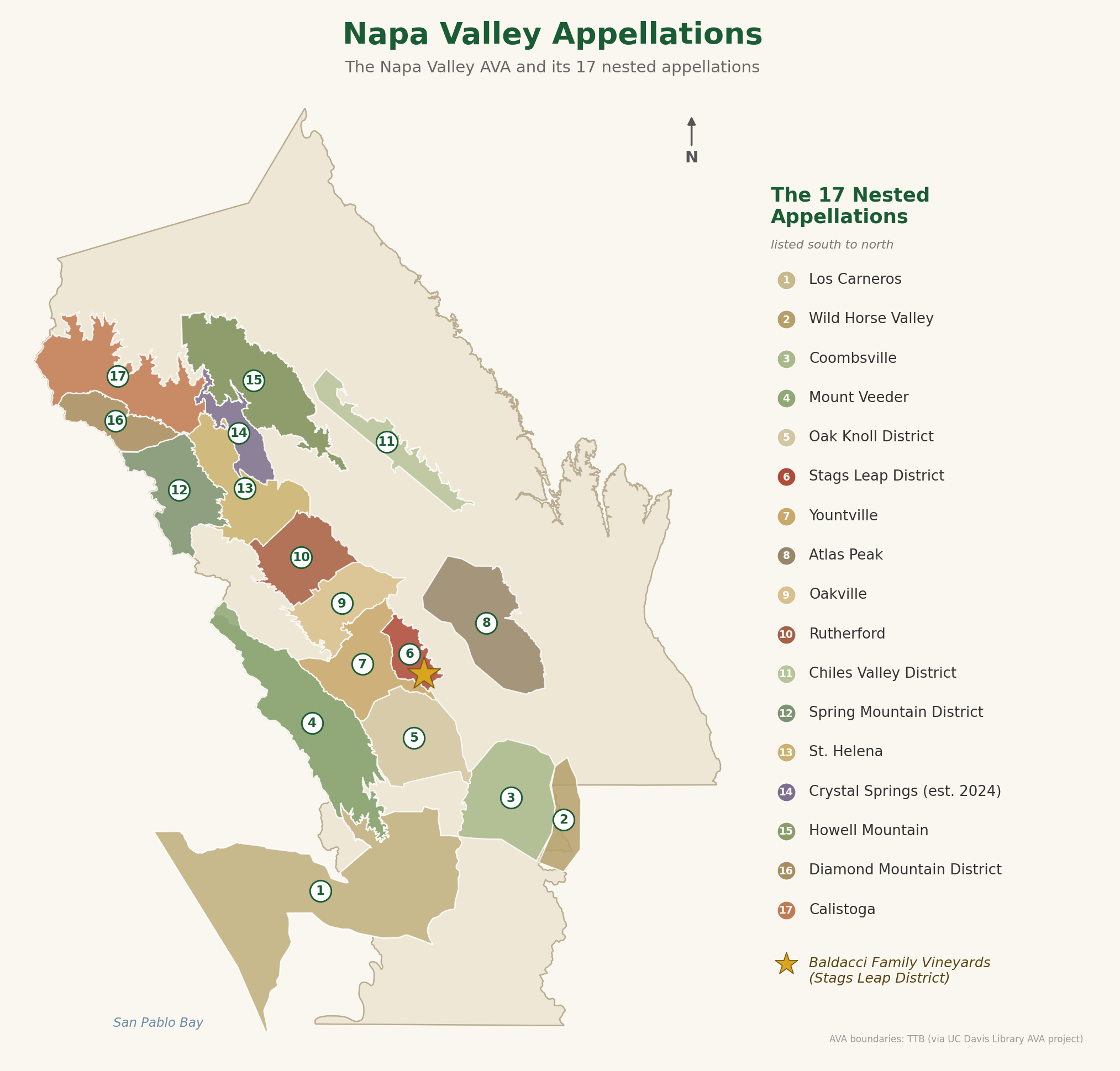
You can think of the 17 sub-AVAs as falling into three main zones: the cool southern end (Los Carneros, Wild Horse Valley, Coombsville, Oak Knoll District), the Valley floor as it warms moving north (Yountville, Stags Leap District, Oakville, Rutherford, St. Helena, Calistoga), and the mountain appellations along the two ranges (Mount Veeder, Spring Mountain District, and Diamond Mountain District on the Mayacamas side; Howell Mountain, Crystal Springs of Napa Valley, Atlas Peak, and Chiles Valley District on the Vaca side). Let’s walk through them together, starting from the south and heading north.
Los Carneros
Carneros is where the ocean makes itself felt. The appellation straddles the southern end of both Napa and Sonoma counties, and its defining characteristic is the consistent marine influence from San Pablo Bay: cool temperatures, morning fog, and strong afternoon winds that push heat out of the vineyards throughout the afternoon. This is not Cabernet Sauvignon country. The climate is closer to Burgundy than to the rest of Napa, and the varieties that thrive here reflect that. Carneros is the valley’s home for Pinot Noir, Chardonnay, and the sparkling wine programs that need naturally high acidity to work.
Carneros wines taste just like you’d expect from the geography: bright acidity and freshness. Whenever I want to show someone a cool-climate contrast within Napa, Carneros is where I start. It’s Napa, but it tells a completely different story in the glass.
I’ve written a full guide to Los Carneros if you want to go deeper on the Valley’s cool southern end.
Wild Horse Valley
Wild Horse Valley is one of Napa’s smallest and least-planted sub-AVAs, tucked into the hills east of the city of Napa. It’s even cooler and more isolated than Carneros, and you’ll mostly find Chardonnay and Pinot Noir here. Very few producers work this land, so the wines are rare outside of specialty wine shops. Wild Horse Valley marks the eastern edge of Napa’s cool-climate character. If you come across a bottle from here, expect something closer to Carneros than to Valley-floor Napa: leaner, with brighter acidity.
Coombsville
Coombsville became an AVA in 2011, making it one of the newer names on the map. It sits in the hills east and southeast of Napa city, protected from the Valley’s heat by volcanic ridges from Mount George. That shelter keeps things cool, so the wines have more natural acidity and a more restrained fruit character than you might expect from this part of Napa. The volcanic soil adds structure, too. Cabernet from Coombsville can really surprise people who think all Napa Cab is big and rich right out of the gate. These wines often need a little more time and really reward your patience.
Oak Knoll District of Napa Valley
Oak Knoll is the coolest spot on the Valley floor, just north of Carneros where the Valley is at its widest, and the Bay’s influence is still felt. What makes Oak Knoll special is its ability to grow both warm-climate grapes like Cabernet Sauvignon and Merlot, and cool-climate grapes like Chardonnay and Riesling, all at a quality you don’t often see elsewhere in Napa. Cabernet from Oak Knoll is usually more structured and restrained than the mid-Valley classics, with good natural acidity and a longer path to full maturity. It might not have the immediate fruit richness of Oakville or Rutherford, but it brings a freshness that keeps the wine lively in your glass.
Yountville
Yountville sits just north of Oak Knoll and gets less of the Bay’s cooling effect, which you can taste in the wines. Cabernet here is a bit riper and more generous than in the southern appellations, but it doesn’t reach the full power of Oakville or Rutherford further north. The appellation is small, and the town is famous for its great restaurants. In terms of flavor, Yountville is a bridge: warmer than Oak Knoll, cooler than Oakville, and the Cabernet sits right in the middle in both structure and style. It’s a great example of how the temperature gradient shapes what ends up in your glass.
My Yountville wineries guide covers the town and its tasting rooms in detail.
Stags Leap District
This is home. The Stags Leap District sits on the eastern side of the Napa Valley, tucked between the Silverado Trail and the Palisades of volcanic basalt that define the eastern edge of the appellation. Those Palisades are the geological story here: the volcanic rock radiates heat back into the vineyards in the evening, the soil is volcanic in origin with a structure that encourages the vine to work for its water, and the combination produces Cabernet Sauvignon that I’ve heard described for as long as I’ve been working in Napa as an iron fist in a velvet glove.
That description really fits. Stags Leap District wines have power and density, but the tannins are polished and fine in a way you don’t find in the mountain AVAs or the richer, fruitier mid-Valley floor. The wines can feel elegant and even approachable when young, but there’s a backbone that develops beautifully with time in the bottle. The Judgment of Paris in 1976 put Stag’s Leap Wine Cellars’ SLV Cabernet at the top of a blind tasting against the best red Bordeaux estates in the world. That wasn’t just luck or a special vintage—it’s what this piece of ground gives us year after year. We farm organically along the Silverado Trail, and from working this land, I can tell you the soil’s complexity always finds its way into the wine.
Oakville
Oakville is where you go to understand what Napa Valley Cabernet Sauvignon became famous for. The appellation sits in the heart of the Valley floor, where deep alluvial soils, warm days, and moderate nights produce Cabernet with serious fruit concentration, structure, and aging potential all working together. This is the address of some of the most celebrated wines made anywhere: Opus One, Screaming Eagle, Harlan Estate, Mondavi To Kalon.
Oakville Cabernets are more approachable when young, with plenty of fruit, but still have the structure to age for years. Oakville’s early accessibility is a big reason it became the benchmark for Napa Cabernet around the world.
Rutherford
Rutherford is just north of Oakville and is famous for Cabernet with a character so distinct that people call it “Rutherford Dust.” That phrase means a dusty, earthy quality on the mid-palate—a texture that’s different from what you find in neighboring appellations, thanks to the clay-rich alluvial soils here. Inglenook and Beaulieu Vineyard’s Georges de Latour Reserve are the classic examples. If you ever taste a great Rutherford Cab next to a great Oakville Cab, you’ll see what I mean: same grape, same latitude, but the soil makes all the difference in the glass. The dust is real.
St. Helena
St. Helena is the most densely planted part of the Valley floor, where the Mayacamas and Vaca ranges come together, and the Valley narrows. That narrowing creates a natural heat trap, with warm days and less breeze than the open southern Valley. This pushes ripeness and gives you some of the fullest-bodied wines in Napa. The wineries here are a who’s who of Napa history: Beringer (the oldest continuously operating winery in the Valley), Heitz Cellar, Duckhorn, Newton. St. Helena Cabernet is a generous, warm-climate wine. It might not have the precise tannin of Stags Leap or the structure of the mountain AVAs, but it brings a richness and fullness that shows what Napa can do at its warmest.
Calistoga
Calistoga sits at the very northern tip of the Valley, surrounded by mountains that block out the marine influence you find in the south. That makes it the warmest spot in Napa, and you can taste it: the wines are generous, with warm fruit and a texture you won’t find anywhere else in the Valley. The soils are volcanic, shaped by the same forces that formed the Palisades to the south, and that volcanic edge adds mineral depth to wines that might otherwise taste ripe.
Calistoga Cabernet isn’t a wine to open too soon, but when it’s ready, it shows Napa at its boldest. Davis Estate is a great example: family-owned, by appointment, with a top-notch food-and-wine pairing program, and wines that really show what happens when Calistoga’s warmth and volcanic soils come together.
Mount Veeder
Mount Veeder sits in the Mayacamas Mountains above Yountville and Oakville, on the Valley’s western side. The elevation brings big swings between day and night temperatures, thin volcanic and sedimentary soils, and wines that are more structured and a bit more austere than what you’ll find on the Valley floor. Mount Veeder is known for Cabernet Sauvignon and Cabernet Franc blends that are leaner, more mineral, and more tannic when young, built to age. The Pacific fog sometimes reaches the western slopes, adding a cool-climate note you won’t find on the eastern side. Mount Veeder isn’t usually where I’d start someone new to Napa, but if you want to see what mountain tannin really means, it’s a must-try.
Spring Mountain District
Spring Mountain sits in the Mayacamas Mountains above St. Helena. Like all of the mountain appellations, it produces wines with more structure and density than the Valley floor at similar latitudes. The soils are a mix of volcanic and sedimentary, and the wines have a distinctly mineral quality alongside the mountain tannin. Spring Mountain is best known for Cabernet Sauvignon and Merlot that can age for decades. The appellation is more rugged in character than the southern mountain AVAs; the wines tend toward restraint rather than generosity, and they reveal their best qualities only with time. For a Napa wine drinker who has worked through the valley-floor benchmarks and wants to explore what the mountains offer, Spring Mountain is a natural next destination.
Diamond Mountain District
Diamond Mountain is a small, high-elevation AVA in the northwest corner of the Valley, just above Calistoga. The soils are volcanic, the elevation is high, and the wines are powerful—you notice it right away. Diamond Creek Vineyards is the historic name here, making three different Cabernets from three soil types on one Diamond Mountain estate (Volcanic Hill, Gravelly Meadow, Red Rock Terrace), showing just how specific Napa terroir can be. Diamond Mountain Cabernet brings together mountain structure and northern-Valley warmth, making a wine that’s truly its own. These are not wines for the impatient.
Crystal Springs of Napa Valley
Crystal Springs is the newest name on the Napa map. Older guides will still say sixteen. It became an appellation in late 2024, the first new appellation in Napa in over a decade. It covers about 4,100 acres of hillside on the lower western slopes of Howell Mountain, between the Valley floor near St. Helena and Calistoga, and just below Howell Mountain’s 1,400-foot line. That in-between elevation is the key: these slopes sit above the thickest morning fog, but below the full mountain exposure, so the fruit ripens differently than either the floor or the ridge. The name is still new so that you won’t see it on many labels yet. Most fruit here has gone into wines labeled just Napa Valley. But the growers who pushed for this AVA showed there’s a real, measurable difference, and that’s what an appellation is all about. I’m excited to see how this one develops.
Howell Mountain
Howell Mountain sits on the eastern side of the Valley, up on the ridgeline above the Valley floor. The vineyards are above the fog line, so the vines get more direct sun and more UV than those on the floor. But that elevation actually narrows the swing between day and night rather than widening it: without fog to trap heat, nights stay warmer up here, and without the Valley floor’s heat buildup, days run cooler than in Pope Valley or St. Helena. The result is Cabernet Sauvignon with dense, concentrated fruit and tannins that really live up to the phrase I’ve used more than once: mountain tannins don’t apologize. A young Howell Mountain Cabernet can seem almost too structured, but at twelve or fifteen years, it’s one of the strongest arguments for patience in wine. The tannins that seemed excessive at four years have integrated and become the wine’s defining asset. Dunn Vineyards is the most famous name from this appellation, and if you want to understand what Howell Mountain Cabernet becomes with time, that’s where you start.
Atlas Peak
Atlas Peak is up in the mountains northeast of Napa city, above Stags Leap District. The elevation is high, and the soils are volcanic, so the wines have a more rustic structure and mineral intensity than most Valley-floor Napa. Antinori’s Antica winery is the best-known name here, with both Italian varieties and Cabernet Sauvignon planted. Atlas Peak isn’t widely known outside Napa circles, but the elevation and volcanic soils give it a flavor profile all its own: structured, mineral, and built to age.
Chiles Valley District
Chiles Valley is Napa’s most isolated appellation, tucked into its own separate Valley east of Howell Mountain. It’s cut off from the marine influence that shapes the rest of Napa, which gives it a more continental climate: less fog, bigger swings between day and night, and a growing season that runs its own way compared to anywhere else in the county. That isolation is exactly why you’ll find more Zinfandel here than almost anywhere else in Napa, alongside Cabernet Sauvignon. The wines can be excellent — concentrated, structured, unmistakably Napa — but production is small, and most of it stays close to home so that you won’t run into Chiles Valley wines often outside local shops. It’s a corner of the Valley worth knowing about even if it’s rarely the first bottle someone reaches for.
What to Do With This Map
If you remember one thing from all 17 sub-AVAs, let it be this: Napa Valley isn’t just one climate. It’s a 30-mile stretch with one of the most dramatic temperature shifts in American wine, mountain ranges that create unique microclimates on every slope, and 17 sub-appellations that really do taste different in the glass. A wine from Carneros and a wine from Howell Mountain might both say “Napa Valley” on the label, but they’re telling completely different stories.
For most people, the best way to use this map is to think about the order you taste. Start with the Valley-floor classics that made Napa famous: Stags Leap District, Oakville, Rutherford. Once you know those, the mountain AVAs and the cool southern appellations make a lot more sense because you have something to compare them to. The Valley really opens up when you’ve spent time with its heart first. There’s no rush—curiosity is the best guide.
If you want to experience the Stags Leap District in person, that’s where our winery is located. The tastings we offer at Baldacci are built around giving you a real understanding of the wines from our three vineyard locations: Calistoga, Stags Leap District, and Los Carneros.
Book your tasting at Baldacci →
Join our wine allocation program →
FAQ
What are the sub-AVAs of Napa Valley? Napa Valley has 17 federally recognized sub-AVAs, each with distinct soil type, climate, and elevation characteristics that produce measurably different wines. They are: Los Carneros, Wild Horse Valley, Coombsville, Oak Knoll District of Napa Valley, Yountville, Stags Leap District, Mount Veeder, Oakville, Rutherford, Spring Mountain District, St. Helena, Diamond Mountain District, Howell Mountain, Chiles Valley District, Atlas Peak, Crystal Springs of Napa Valley (established 2024), and Calistoga.
How many appellations does Napa have? Napa Valley has 17 sub-appellations (sub-AVAs) within the broader Napa Valley AVA, plus the Napa Valley AVA itself. When people say “Napa appellation,” they typically mean the Napa Valley AVA. When they say “Napa sub-appellations,” they mean the 17 district designations that indicate where within the valley the fruit was grown.
What is the difference between the Napa Valley AVAs? The differences come down to three measurable variables: distance from San Pablo Bay (Carneros runs 10 to 15 degrees cooler than Calistoga), elevation (mountain AVAs above the fog line produce firmer tannin than the Valley floor), and soil origin (volcanic on the ridgelines and eastern floor, alluvial clay and gravel mid-valley): same grape, different ground, recognizably different wine.
Is there a map of Napa Valley wine regions? Picture the Valley as a 30-mile corridor running south to north, from the city of Napa to Calistoga. Los Carneros, Wild Horse Valley, Coombsville, and Oak Knoll District anchor the cool southern end. The Valley’s floor warms as you move north through Yountville, Stags Leap District, Oakville, Rutherford, and St. Helena to Calistoga. Mount Veeder, Spring Mountain District, and Diamond Mountain District climb the western Mayacamas range, while Howell Mountain, Atlas Peak, and Chiles Valley District sit in the eastern Vaca range.
What is the best Napa AVA for Cabernet Sauvignon? There is no single best. The answer depends on the style you prefer. For polished, fine-grained tannin with power, the Stags Leap District is the classic answer. For maximum fruit concentration and accessible depth with serious aging potential, Oakville is the benchmark. For structured, demanding wines built for decades in the cellar, Howell Mountain. For rich, warm-climate generosity at the northern end of the valley, Calistoga. Each delivers something different, and each has produced wines that belong in any serious conversation about what Cabernet Sauvignon can become.
What is the difference between Napa Valley AVA and Stags Leap District? Napa Valley is the parent appellation that covers the entire county. Stags Leap District is a smaller, more specific sub-AVA within Napa Valley, covering a section of the eastern valley floor between Yountville and the Vaca Mountains. Fruit labeled “Stags Leap District” must come from within that defined boundary. It is a more specific terroir claim than “Napa Valley.”
What is Rutherford Dust? Rutherford Dust is a term used to describe a dusty, earthy quality on the mid-palate that appears consistently in Cabernet Sauvignon grown in the Rutherford appellation. The character is tied to the clay-loam alluvial soils of the valley floor in that part of the Valley. It’s real in the sense that people who have tasted extensively from Rutherford can identify the quality in a blind tasting, and it’s been used for decades as evidence that place contributes a measurable signature to the wine beyond what variety or winemaking technique can explain.
What is the difference between Howell Mountain and Stags Leap District Cabernet? These are two of the most frequently compared Cabernet appellations in Napa, and they produce wines that are recognizably different. Stags Leap District is a valley-floor appellation known for Cabernet with power and unusually fine, polished tannins: an iron fist in a velvet glove. Howell Mountain is a mountain appellation on the eastern ridgeline with thinner soils, wider temperature swings, and Cabernet with dense, structured tannins that require significant bottle aging to show their best. Stags Leap is more accessible in youth. Howell Mountain demands patience and rewards it.
Where is Carneros in relation to Napa? Los Carneros sits at the southernmost end of Napa Valley and straddles the border between Napa and Sonoma counties. It is the appellation most directly influenced by San Pablo Bay: morning fog, cool temperatures, and strong afternoon winds make it the coolest appellation in the Napa AVA system and the primary location for Pinot Noir, Chardonnay, and sparkling wine production. It runs 10 to 15 degrees cooler than Calistoga at the northern end of the Valley.
What makes Calistoga different from other Napa appellations? Calistoga sits at the northern tip of Napa Valley, ringed by mountains that block the marine influence that defines the southern end. It is the warmest appellation in Napa, consistently running 10 to 15 degrees warmer than Carneros. The volcanic soils and the heat produce Cabernet Sauvignon with warm fruit and texture, generous and full-bodied with a mineral depth that comes from the volcanic character of the terrain.
Which Napa Valley appellation is best for Pinot Noir? Los Carneros is Napa’s answer to that question. The cool temperatures, consistent fog, and Bay influence make Carneros the only part of Napa Valley with a climate consistently suited to Pinot Noir and Chardonnay at a serious level. Coombsville has also produced promising Pinot in cooler years, but Carneros is the established benchmark for cool-climate varieties in the county.
Do I need to visit all the Napa Valley appellations to understand them? You don’t, but tasting wines from different appellations side by side teaches you more than any map can. The most useful sequence: start with Stags Leap District and Oakville to get the valley-floor benchmark, then compare against a mountain appellation like Howell Mountain to feel what elevation does to tannin structure. From there, the rest make sense because you have reference points.
Michael Baldacci is the Winemaker at Baldacci Family Vineyards, Stags Leap District, Napa Valley.